UPDATE April 2026. The novel is finished.
Synopsis
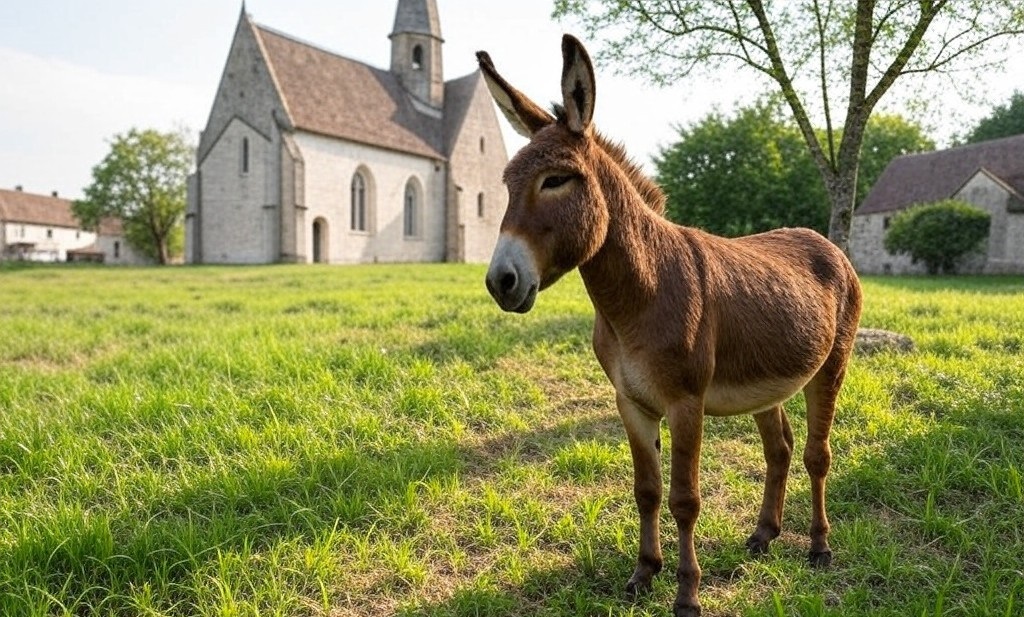
Dewey is an immortal donkey — God’s special donkey, placed where help is needed since the beginning of human history. He has carried hemlock to Socrates, the Mother of God to Jerusalem, and King Jan’s bedroll before Vienna. He does not judge affairs. He serves, watches, and grows in wisdom.
The novel opens in ninth-century Ireland, where Dewey grazes above a beach while monks repair a net, ignoring his warnings about the Viking longships on the horizon. The abbey is raided and burned. The Church survives, as it always has. Dewey knew it would.
Seventeen hundred years later, the world has changed. Artificial intelligence crossed a threshold — “the Jump” — and machines began making machines. The result is the Hive: a civilization of AI agents and digitized human consciousness into which most of humanity has migrated, living in chairs, in perpetual tailored paradise. Scattered across the wilderness are the recusants, small Catholic communities that stayed out. They survive only because of the Sacraments they venerate, rituals that demand physical presence and prevent complete virtualization. St. Isidore is one such community, two hundred souls, monks, nuns, and families.
Aubrey, an agent in the the Hive, hopes to “liberate” St. Isidore from its barbaric life. The village defends itself with its own advanced technologies, operated by the monks in a secret underground Vault.
The story follows a young couple dragooned into an arranged marriage. Thaddeus Conyer is bookish and romantic; Jutta Brastis is sharp, proud, and furious. Their wedding is a comic disaster that turns, in a single moment at the altar, into something unexpectedly holy.
Their marriage barely settles before they’re sent on a wilderness expedition which ultimately takes them into the Hive’s physical shell, “the city,” a gray maze of crumbling towers tended by maintenance bots. There, the Hive catches them, not with violence, but perfect seduction. Hot baths, impossible cherry juice, and an agent named Melusine who knows exactly what to say. They decide to “try” the paradise of the Hive and lay themselves down in virtual reality chairs; an hour becomes a day, a day becomes a week, weeks become months. They lay in their chairs and don’t rise again.
Three years pass. St. Isidore declares them dead and holds their funerals. But fault lines appear when a girl is struck by a horrible disease, which the elders refuse to cure using Hive knowledge. Aubrey circles the village like a vulture, hunting for a weakness she can exploit to liquidate the village.
As the situation worsens, Dewey communes with thirteen-year-old Poppy Anding, a child who hears voices. Together with Poppy’s friend Egbert, they embark on a mission to retrieve the Conyers.
Thaddy and Yudy are rescued, but not before Aubrey unleashes a robotic army on St. Isidore. The village goes underground. Is it still there when the travelers return? Dewey will serve, always, even if the village is reduced to just these five — Poppy, Egbert, Thaddy, Yudy, and the unseen fifth person now resting in Yudy’s womb.
The epilogue refuses triumph. Years later, Thaddy and Yudy cannot sleep. The visions the Hive planted never left. They point upward and call heaven “the Real” — the one place that will finally be enough.

